
First Lessons from the 3-Day ILA Strike

(comments are welcome)
The Organizer Editorial by Alan Benjamin
(www.socialistorganizer.org)
“The terminal operators [the U.S. Maritime Alliance, or USMX] got real rich during Covid when everybody stayed home while my people went to work every single day and some of them died on the job.”
These words were spoken by Harold Daggett, president of the International Longshore Association (ILA), at the beginning of the three-day strike that shut down ports up and down the East Coast. “We make their money and they don’t want to share it with us,” Daggett continued.
Daggett is no union reformer, no Shawn Fain (UAW); in fact, he has enjoyed a longstanding relationship with Donald Trump. A posting on Forbes magazine’s website (October 4) reported that Daggett had placed all his hopes on Trump to help resolve the confrontation with the USMX and to secure a fair contract for his members.
A recent posting on the ILA website contained excerpts from Daggett’s report on his 90-minute meeting with Trump to illustrate this point:
“President Trump promised to support the ILA in its opposition to automated terminals in the U.S. Mr. Trump also listened to my concerns about Federal ‘Right-to-Work’ laws, which undermine unions and their ability to represent and fight for their memberships.”
These, of course, are all misplaced illusions and false promises. Trump is in the pocket of USMX and its Big Business and high-finance partners. He’s no friend of labor.
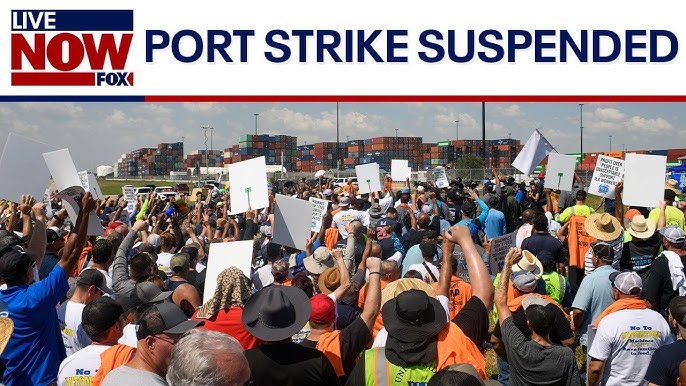
ILA’s rank-and-file were key to 3-day strike and unprecedented wage increase!
Having said that, Daggett was compelled by the movement from below – from the rank-and-file in his union – to issue the strike call. Labor Notes (October 2024) reports that, ‘While, under the ILA constitution, workers do not have to hold a vote to strike, several locals held votes and were unanimously in favor of striking.”
Thus began the first strike on the East Coast and Gulf Coast ports since 1977.
“[The union [l]eadership exercised tight control over picket lines, with members refusing to speak to reporters, but those who broke protocol said they were inspired by last year’s Stand-Up Strike and by the Big 3 Auto Workers and the UPS Teamsters’ contract campaign.” (Ibid.)
The pressure from the rank-and-file is what forced the ILA to down their tools. It also compelled the bargaining team to be more combative and to stand more firmly in support of a substantial wage increase, a pension for the entire workforce, and, it appears, a halt to the expansion of Automated Intelligence (AI) in the terminals.
The longshore workers understood that they had to rely on their own collective power to win their demands – not Trump, and not Biden, who two years earlier had threatened to invoke Taft-Hartley (through the Railway Labor Act) should the rail workers go ahead and strike. The result? After three days on strike, the ILA won a $24 an hour wage increase – that is, a 62% pay raise — over six years!
USMX’s demands on automation lead to stalled negotiations
But, as the West Coast ILWU longshore workers learned, the bosses will not relent with their demand to expand automation in exchange for pay increases. This is the case of the ILA workers and their contract.
“California dockworkers have already lost jobs because of automation,” a mechanic with ILA Local 1804 on the Elizabeth, New Jersey, picket line told Labor Notes. “We are trying to prevent that from happening to us.” (Ibid.)
It was on this key issue of automation that talks broke down and that a mutual agreement was reached to stop negotiations and return to the table in mid-January, six weeks after the presidential election.
According to some sources, the union’s bargaining team was not willing to accept modifications to work rules that would have opened the floodgates to increased automation. But according to other sources, the agreement appears to have raised or eliminated a cap on employer contributions to a special compensation fund aimed at offsetting the expected job losses. Details are unclear.
What is clear, however, is that the ILA rank-and-file have not said their last word. Just as the rail workers twice rejected their union’s bargaining team’s proposed contract, just as the autoworkers and the Boeing workers rejected their union leaderships’ tentative agreements, so too might the ILA workers reject their union’s tentative agreement should USMX insist on exacting concessions on automation and pensions in exchange for this substantial wage increase.
Regarding pensions, Labor Notes writes: “Pensions remain a sore spot in the ILA. Workers in Houston and Philadelphia have no pension at all, while many other East Coast workers have barely discernible ones. Pensions on the West Coast are uniform across ports, and higher overall.” (Ibid.)
Automation and pensions still need to be negotiated.
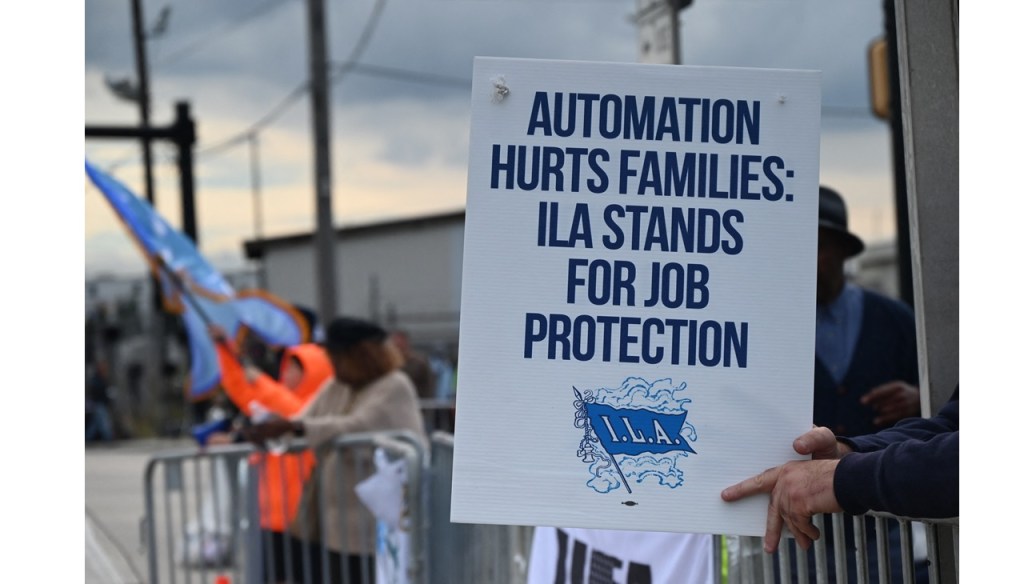
Longshoremen carry signs and demonstrate outside the APM terminals in Elizabeth, New Jersey, United States, on October 1, 2024, as members of the International Longshoreman’s Association strike after their contract expires at midnight. (Photo by Kyle Mazza/NurPhoto) (Photo by Kyle Mazza / NurPhoto /
NurPhoto via AFP)
Role of Biden and the Democratic Party
Notwithstanding Daggett’s public announcement that he would not call upon Biden and the Democratic Party to assist with contract mediation, Transportation Secretary Pete Buttiegeg and Labor Secretary Julie Su became involved with the ILA contract talks beginning last summer.
Biden and the Democratic Party had lost significant support from officials and members of unions across the country for their threat to invoke Taft-Hartley and ban a rail strike in 2022. Clearly, they did not want another black eye. The financial press reported that Biden and his mediators were leaning heavily on the ILA and the employers to settle.
Biden didn’t want to have to call upon the National Guard to put down the “illegal” strike on the home stretch toward the election. It could have upset Kamala Harris’s presidential bid. On September 20, Biden announced that he would not invoke Taft-Hartley (by means of the Railways Labor Act) to order ILA members back to work.
When the contract talks resume in mid-January, independently of who, Harris or Trump, wins the election, you can be sure that the Democrats will be leaning a lot more heavily on the union than on the employers to make concessions on pensions and automation. This has been the pattern of all recent union bargaining sessions.
Biden is now being praised by the labor movement for his role in the contract negotiations. This praise might be premature. While the wage increase is substantial — product of the mobilization of the ranks — the heavy lifting (pensions and automation) is still to come. A Harris administration, assuming that she wins, could very well be confronted with an East Coast ILA strike.
Fight for a Labor Party now!
Whether it comes to the war on working people here at home, or whether it comes to the wars on workers and the oppressed around the world, working people are under attack.
Just as the workers on the shop floor need to fight for unions that are genuinely independent of the employers and their surrogates (as the UAW Reform Caucus is doing by hosting a Reform Caucus convention this past weekend), so too must they fight to assert their independence in the political arena.
It is a deadly illusion to think that the Democratic Party can ever be a lever for working-class struggle. We agree and support the resolution adopted by the national AFL-CIO convention in 2017, which states, in part:
“The October 2017 national convention of the AFL-CIO affirms that, whether the candidates are elected from the Republican or Democratic Party, the interests of Wall Street have been protected and advanced, while the interests of labor and working people have generally been set back.” A second convention resolution concluded that, “the time has passed when we can passively settle for the lesser of two evils politics.” The committee’s goal will be to promote the discussion inside the labor movement about the need to break with the “lesser of two evils politics” and to create a “Labor-Based Political Party” — a reference to the title of a forum organized by key labor officials at the October 2017 AFL-CIO convention. In order to create such a mass working-class party, we will organize to raise awareness in the unions of the need to break with the Democratic Party.”
We in Socialist Organizer and The Organizer newspaper have proudly upheld the banner of working-class independence and internationalism – and we will continue to do so. We want to hear from you!
We invite you to join our ranks and to support the important effort to build a mass working-class party rooted in labor and oppressed communities promoted by Labor and Community for an Independent Party (LCIP) – breaking clearly with the Democratic Party.
 Socialist Organizer