
T.O. 134: Regional War Threats / Labor Day Int’l Solidarity / Bangladesh Uprising / Housing Crisis

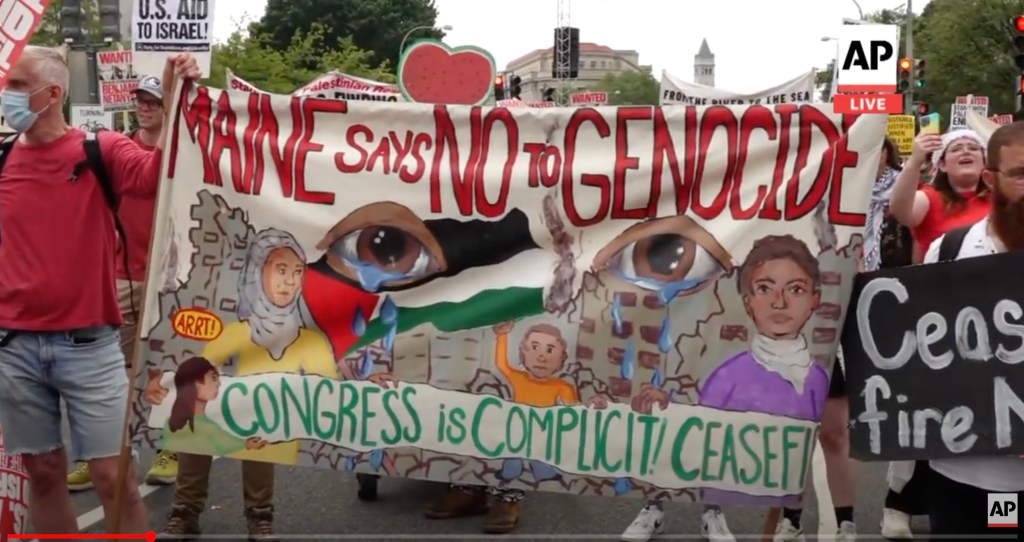
Threats of War Engulf the Middle East, We Demand: “Stop Arming Israel”!
Editorial by Mya Shone
On Sunday, August 11, Defense Secretary Lloyd Austin beefed up the already formidable U.S. military fortress protecting the Zionist state. Israel, the U.S. and other imperialist powers are anticipating Iran’s retaliation for yet another Israeli strike on the Islamic state.
Aside from the many assassinations of Iran’s nuclear scientists over the years, on April 1, Israeli F-35 warplanes launched six missiles against the Iranian consulate in Damascus Syria killing Brigadier General Mohammad Reza Zahedi and other Islamic Revolutionary Guard Corps commanders. Tehran struck back on April 13-14 with a large drone and missile attack which was intercepted by Israel and a coalition of six nations, foremost among them the United States. Israel then reciprocated with an attack on Isfahan on April 19 despite a U.S. warning that enough was enough. Iran, however, took the hit and didn’t fall into the Israeli trap.
Three months later, on July 25, Prime Minister Benjamin Netanyahu spoke before a joint session of the U.S. Congress where he received a rousing reception from most who attended. Netanyahu made his position clear. Iran had created an “axis of terror” that confronted not only Israel but America and “our Arab friends.” He defined it as “a clash between barbarism and civilization” which required America and Israel to “stand together” … “for the forces of civilization to triumph.”
He urged the United States to form “a security alliance [ed note: similar to NATO] in the Middle East to counter the growing Iranian threat.” He called it the Abraham Alliance – an extension of Trump’s Abraham Accords thus enshrining Israel’s false notion of its Biblical right to the land of Palestine.
Netanyahu met separately with President Joe Biden and Vice President Kamala Harris, now the Democratic Party presidential candidate, before he flew down to Mar-a-Lago to meet on July 26 with former President Donald Trump, the Republican Party nominee.
Just a few days later, on July 31, Israel struck Iran again, assassinating Hamas political leader Ismail Haniyeh — who had been Hamas’ chief negotiator in the ceasefire talks — while Haniyeh was in Tehran, the Iranian capital, attending the state funeral for Iran’s president. Iranian leaders made it clear: Iran had no choice but to strike back.
By Monday evening, August 12, the leaders of the United Kingdom, France and Germany issued a joint statement urging Iran and its allies to “refrain from attacks that would further escalate regional tensions”. Iran’s new president Masoud Pezeshkian responded to the British Prime Minister Keir Starmer that it had a legal right by international law to respond. The Iranian state news agency further reported that Pezeshkian told Starmer bluntly that “Western countries’ support for Israel had encouraged it to ‘continue atrocities’ and threatened peace and security.”
The Pentagon didn’t bother with talk. It had already reacted by deploying the guided-missile submarine USS Georgia to the Middle East and speeding up the voyage of the USS Abraham Lincoln aircraft carrier strike group, which had already been on its way.
By Monday, August 12, the USS Laboon, a destroyer, arrived in the Eastern Mediterranean to join the destroyers USS Roosevelt and USS Bulkeley and a three-ship amphibious task force that includes the USS Wask, the USS Oak Hill, and the USS New York, already in the region.
Are the U.S., U.K., France, and Germany ready politically for another regional war with financial resources already extended as a result of the Russia-NATO provoked war in Ukraine? Are they ready to test China which relies upon Iranian oil? (China imports 90% of Iran’s substantial oil production and provides additional funding to maintain Iran’s oil infrastructure.)
Neither Israel nor Iran are “built for major war,” concluded the IISS, the International Institute for Strategic Studies, a prestigious think tank in Great Britain, May 17, 2024. “Excluding Israel’s undeclared nuclear capability,” it stated in its comprehensive analysis, “both sides arguably lack the ability to overwhelm militarily the other.” Their obvious conclusion: each would depend upon foreign support.
Then there is the Israeli population itself. A vast majority of the Israeli population (60%), including its generals, are fed up by now with Prime Minister Netanyahu’s genocidal strategy of “absolute victory” against the Palestinian people and its struggle for self-determination. Large protests support a ceasefire with the return of Israeli captives (alive and dead). Israelis displaced from the war, 250,000 so far from communities near Gaza and Lebanon borders, are eager to return home.
Netanyahu must up the ante to maintain his position in power with his best bet to rope the Israeli people and imperialist powers into a “defensive” regional war. That is the purpose of the long-range F-35 strategic fighter jets that the Israel purchases like candy through the U.S. Defense Department with U.S. taxpayer monies.
Designed and manufactured by Lockheed Martin, the F-35 is a joint project with Northrop Grumman, BAE Systems and Pratt & Whitney. More than 1,900 suppliers build components in 48 U.S. states and in more than 10 countries. Lots of money to be made at the cost of $109 million per aircraft.
Now, more than ever, the demand must be Stop Arming Israel. It is not only the Palestinian people but the lives and sovereignty of peoples through the entire region of the Middle East and beyond.
This Labor Day and in the days ahead, U.S. workers can demonstrate that the historic labor slogan remains the battle cry: “An Injury to One is an Injury to All.”
Check for protests in your city. Join us as we raise our banners high demanding Stop Arming Israel! Let us persist until not one more U.S. bomb, bullet, plane or tank is shipped to Israel.
* * * * * * * * * *
Socialist Organizer Needs Your Support!
Many of you have told us that you appreciate The Organizer and distribute it widely. We depend upon you to broaden our reach. We also rely upon you to assist with the cost of publication and our other efforts, such as holding forums and organizing conferences. Contribute today using the PayPal link on our website. Monthly sustainer contributions of $5, $10, or more, are greatly appreciated.
Above all, let us remember. We chose our name The Organizer for a purpose. Contact us to learn more about and get involved with Socialist Organizer. Don’t put this off for another day — we look forward to hearing from you.
* * * * * * * * * *

All Out Labor Day and in the Days Ahead with Banners Demanding Stop Arming Israel!
On July 21, seven national unions, representing more than 6 million workers, called upon President Joe Biden “to halt all military aid to Israel”. Mark Dimondstein, the American Postal Workers Union (APWU) president, spoke forcefully at the July 24 rally in Washington D.C. organized to protest Israeli Prime Minister Benjamin Netanyahu’s harangue before Congress.
That was a great start. Now is the crucial moment to broaden labor’s reach. There is no time to lose. Every day that passes by, even every minute matters. This is one of those historical moments that require action. It is not the time to hesitate.
The situation is dire.
The IDF is dropping bombs supplied by the U.S. government almost daily on schools where Palestinians have sought shelter.
On August 1, the IDF bombed Dalal al-Maghrabi school in the Shujayea neighborhood of Gaza City killing 15 and injuring at least 29.
On August 3, the Hamama and al-Huda schools in the Sheikh Radwan neighborhood killing 17 and injuring 60.
On August 4, the Nassr and Hassan Salameh schools in the Nassr neighbood resulting in 30 dead and 19 injured.
Then again on August 8, bombs were dropped on the Abdul Fattah Hamouda and az-Zahra schools in the Tuffah neighborhood with 17 dead, dozens missing injured and still more missing under the rubble.
On August 10, Israel intensified its attack. Three bunker-busting bombs, each weighing 2,000 pounds, were dropped on. the al-Tabin school in the Daraj neighborhood. One hundred Palestinians died immediately and many dozens more were wounded. Many more may die as the bombs triggered a fire that swept through the complex and medical care is unavailable to treat those burned and injured.
Ask yourself: What am I doing to make this genocide end?
The Labor Fightback Network has issued a call: “All Out Labor Day to Stop the Wars Against Working People at Home and Abroad.” (see statement posted to socialistorganizer.org). We urge readers of The Organizer to sign on, get engaged, and promote this effort in your union locals and internationals as well as solidarity organizations.
This Labor Day and in the days ahead, U.S. workers can demonstrate that the historic labor slogan remains the battle cry: “An Injury to One is an Injury to All.” All out this Labor Day and in the days ahead with banners demanding Stop Arming Israel!
* * * * * * * * * *
What’s Happening in Bangladesh?
(Part 1 – August 6, 2024)
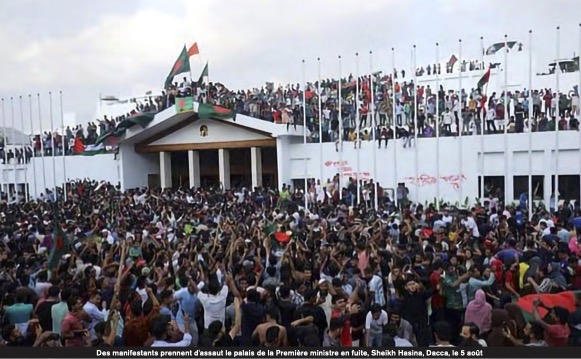
On August 5, 2024, the government that murdered students was overthrown. In the morning, hundreds of thousands of people stormed the government palace in Dhaka, forcing Prime Minister Sheikh Hasina to flee by helicopter to India. They put an end to the reign of her Awami League government which had been in power since 2009.
During the previous month, Hasina had unleashed a bloody crackdown on students demonstrating against an unfair and unequal quota system for government jobs, which in Bangladesh offer the rare opportunity for stable work, healthcare, and a pension. More than 3,000 were arrested and 300 people –the vast majority of them youth – were killed by police and Awami League militiamen, including around 100 on August 4 alone.
Sheikh Hasina’s government claimed to be “progressive”. It repeatedly accused the students of being reactionary. But what is “progressive” about shooting unarmed young people who are demonstrating to defend their right to a future?
“Quotas” in Bangladesh reserve access to civil service jobs primarily to “descendants” of the fighters in the national liberation war of 1971. But In reality, the system is used to restrict access to public jobs to the regime’s “clientele”, while millions of university-educated youth remain unemployed.
“Take back your quotas and give us back our brothers”, chanted the students as their protests grew in numbers and spread throughout the country. The Awami League government responded immediately with force, quick to spill blood because, since it was formed in 2009, it has subordinated itself to imperialism, to the plans of the International Monetary Fund (IMF) and to the consequences: austerity, privatization, over-exploitation, and misery.
It is this government that has given a free hand to the textile multinationals, who mercilessly exploit the proletariat, while tragic accidents like the Rana Plaza [1] take place. In Banglasdesh, it is the government that represses workers’ strikes. It is the government that refuses to re-nationalize what the prior reactionary government, the Nationalist Party (BNP), had privatized, such as the major port of Chittagong.
That Awami League government must be described for what it is: a “popular front” government, in other words, an alliance of workers’ parties with the bourgeoisie. The Awami League – the old nationalist and secular bourgeois party – received, right up to the last minute, the shameful support of certain “left” parties, particularly those that emerged from the Communist Party crisis.
It is no coincidence that thousands of demonstrators wave the national flag. This 2024 revolutionary uprising is a continuation of the heroic revolutionary war of 1971, which liberated Bangladesh from the yoke of the Pakistani military dictatorship [2].
Today, what the masses – and in particular the youth, workers, and peasants – want is not only the students’ demands to be met and for those responsible for the repression to be punished, they struggle to have the national, democratic and social demands on which the survival of working people depend realized. As this statement is being written, the country is in disarray.
The army general staff, seeking to re-establish order, has brought together all the reactionary parties – from the fundamentalists of Hefazat-e-Islam to the old right-wing BNP – deliberately sidelining all the workers’ parties that took part in the demonstrations.
For the military hierarchy, the aim was to form a “transitional government” that would preserve imperialist domination.
As with any event that sets millions of men and women in motion, the absence of a workers’ leadership up to the task ahead leaves room for reactionary forces, and behind them imperialism. [Ed. Note: Muhammad Yunus, the Nobel Peace laureate for his developing a micro-financing system, returned from exile to be the interim figurehead president.]
In these difficult circumstances, it is the duty of workers throughout the world and their organizations to stand shoulder to shoulder with the workers and youth of Bangladesh.
It’s their duty to reject all imperialist interference and all schemes aimed at preventing the workers, peasants and youth of Bangladesh from imposing a solution in their own interests.
• Written by the editorial staff of Workers’ Tribune, based on information sent by our comrades in Dhaka and Chittagong
ENDNOTES
[1] On April 24, 2013 in Rana Plaza, near Dhaka, a dilapidated building housing subcontracting workshops for textile multinationals collapsed. The death toll was 1,100, most of them women workers exploited in the workshops.
[2] In 1947, British imperialism was ousted from its Indian Empire. British imperialism then pushed for partition to maintain its domination with other forms. India and Pakistan were separated on artificial grounds. Thousands of miles from Pakistan, the people of “East Pakistan” – now Bangladesh – who had their own language and culture expressed their aspirations for national emancipation. A revolutionary war of liberation began in 1971, defeating the Pakistani military regime and wresting independence.
– – – – – – – – – – – – – – – – – – – – –

What’s Happening in Bangladesh?
(Part 2 – August 13, 2024)
All the information we receive from Bangladesh confirms: The student mobilization, underway for weeks, has begun to transform itself into a workers’ revolution.
This was expressed particularly in full force on August 4, when hundreds of thousands of workers converged on the capital. It was precisely in response to this assessment of the situation that the army organized the removal of Awami League Prime Minister Sheikh Hassina and her family, who had taken refuge in their palace.
Since then, all the institutional forces in Bangladesh, in the region and internationally, scurried to find a solution to re-establish a “stable” regime that would ensure the ongoing exploitation of textile workers.
On August 8, economist Muhammad Yunus, returned from exile, whereupon he was called upon to head an interim government, announcing that he would restore “law and order”. The U.S. government immediately supported the new interim government and declared itself ready to work with him. The chargé d’affaires of the U.S. Embassy in Dhaka (capital of Bangladesh) attended the ceremony at which Yunus presented his provisional government.
The European Union announced in a statement by the head of its diplomatic corps that “it looked forward to working with the new administration”. For his part, Yunus launched an appeal for “national unity”, and announced his intention to hold elections “within a few months”. Our correspondents in Bangladesh sent us this information:
The current upheaval confirms the analyses of our party’s founder, our late comrade Tafazzul Hussain. Both the Awami League and the BNP [Bangladesh National Party – editor’s note] are mainly controlled by the imperialist powers and multinational corporations. This is also true of the Jamaat-e-Islami.
This is why no strong anti-imperialist movement and no government has been able to respond to the needs of the people. On the contrary, left-wing political parties have benefited from unity with the governing party. They have always favored sharing power with Hassina’s bourgeois government. This allegiance to the Awami League government of parties that claim to be of the working class was expressed at every turn.
One of our correspondents described the situation as follows:
At the time of this writing, much is still uncertain. The trade union representatives have agreed to be integrated, one way or another, into the new government. Some union leaders were present at the inauguration of the interim head of state, but we don’t know what agreements were reached.
One thing is certain: thousands of students continue to meet, discuss and organize – and the workers are calling to challenge the power of the multinationals while they call for an end to exploitation.
• Written by the editorial staff of Workers’ Tribune, based on information sent by our comrades in Dhaka and Chittagong
* * * * * * * * * * *

Criminalizing Victims of the Capitalist Housing Crisis
By Millie Phillips
It is no secret that the United States has a housing crisis. Every major city has massive encampments of people living in tents or sleeping in vehicles. Without adequate public funding for social services and affordable housing, non-profit charities and faith organizations scramble to provide food, health and hygiene products, and referrals to other charities and understaffed and over-extended local government agencies, most of which have no actual housing to offer.
To add insult to injury, the Supreme Court ruled June 28 that local jurisdictions can forcibly clear encampments and criminalize anyone who sleeps on the street or in a public park. This does not “solve” homelessness. Where are unhoused people supposed to go? How does breaking up their makeshift communities and often stealing or destroying their possessions help them become sheltered? Why should a status forced on people by government policies and real estate industry greed potentially be a criminal offense?
At the beginning of 2023, a record-breaking high of over 635,000 people in the U.S. were counted as unhoused, a 12% increase over the past year, with close to a third of them in California. Point-in-time counts record only those visibly unhoused, so the number is probably much bigger. While accurate statistics for 2024 are not yet available, there is no sign of overall improvement. (For statistics in this article, see State of Homelessness 2024 Edition.)
The main cause of homelessness is high rent combined with low incomes. Per the State of Homelessness report, “when median rents increase $100, homelessness rates rise by nine percent. From 2001-2022, median rents increased 19 percent after adjusting for inflation.”
“Meanwhile, since 2001, median incomes of renter households increased just four percent after adjusting for inflation.” A comprehensive study shows that almost half of unsheltered people are formally employed and many receive supplemental disability or Social Security payments.
In California, median monthly rent for a 1-bedroom apartment is $1870. In San Francisco, 1- bedroom units usually cost between $2800-$3500 and in the low $2000s in Los Angeles. An “extremely low waged” (less than 30% of area median income) worker in California would only be able to pay $530 not to be considered rent-burdened, that is, paying more than 30% of their income for rent. Vast numbers of existing renters are at risk of becoming unhoused, with poverty in the U.S. increasing 15% from 2019 to 2022 and Covid pandemic tenant protections expired.
Many renters and even homeowners crowd numerous residents into their living spaces just to afford rent or avoid foreclosure. Almost no younger adults can qualify for a mortgage – in many parts of California, house prices average over $1 million – and high rents ensure they cannot save for a down payment. 50 years ago, most young people left their parents’ homes in their late teens; now many continue living with their parents or rely on them to help with rent, adding to the financial burden on seniors, who increasingly must postpone retirement to survive. Not surprisingly given the long history of racial housing discrimination in the U.S., all the statistics cited above impact BIPOC far more severely than white people.
Following the Supreme Court decision to allow the criminalization of homelessness and destruction of encampments, California Governor Gavin Newsom issued an executive order demanding that local jurisdictions remove encampments. He even posed for photo-ops while helping destroy one on state land. Nonetheless, some cities have refused; Los Angeles among them, recognizing that unhoused people have nowhere to go.
At the local level, efforts are made to deal with the housing crisis, such as by passing ordinances protecting tenants from high rent increases (“rent control”) and unfair evictions that might force them onto the street. [*] They do help, but barely make a dent in the need. Plus, once passed, laws need to be enforced, which often requires entirely new campaigns.
Besides, in California, current state law limits rent control only to apartments built before certain dates, and exempts most single-family houses, condos, mobile home parks, and even apartments built to be designated as “affordable.” For covered units, the state cap is up to 10% annually, though cities can pass lower caps.
Since long-time occupants of rent-controlled units are often seniors who usually can’t afford to move, this reduces available rentals even further. Sadly, seniors without such protections are, percentage-wise, the most rapidly growing segment of the unhoused.
Homelessness is not new. It was common in the U.S. before the Great Depression of the 1930s and the implementation of the New Deal, which included massive building of subsidized public housing, albeit racially segregated and often of poor quality.
But once such construction was stopped in the 1970s, homelessness rose steadily again. Though the despair created by being unhoused can lead to mental illness and addiction, most unhoused people did not already have such conditions, as is commonly assumed. However, the crisis was aggravated by the closing of state hospitals for the mentally ill and developmentally disabled.
Similar excuses were used to stop building or tear down public housing and to close mental hospitals – public housing had resulted in slums and mental hospitals were abusive, prison-like warehouses. Yet, to the extent there was truth in these assessments, it was because of the government’s own policies of neglect, grounded in racism and contempt for poor and disabled people generally. Also contributing were huge tax reductions for the rich and rampant government enabling of real estate speculation.
Capitalism, which created this crisis by making housing strictly a commodity rather than a human right, offers no solution. In the private market, it is simply not profitable to build affordable housing. California would need over two million new units to meet demand. Rather than fund construction or regulate the real-estate industry adequately, federal and state governmental policies have freed up the industry to gouge workers for all we’ve got.
Meanwhile, half of the U.S. government’s discretionary budget goes to the military. Currently, the U.S. is directly paying for Israel’s genocide of the Palestinians, which has included the destruction of virtually all housing in Gaza.
Not surprisingly, since both parties are funded by the capitalist ruling class, which profits greatly from war, speculation, and government-imposed austerity measures; policies creating homelessness and housing insecurity continue to occur under both Democratic and Republican administrations.
Until the working class has its own voice independent from the Democrats and Republicans, we can only expect more of the same. This is why Socialist Organizer advocates the construction of a new political party grounded in and led by oppressed communities and organized labor, a party built from the bottom up to organize all impacted by capitalist greed to rise up and fight back.
We demand: Housing is a Human Right!
[*] The author worked to pass such tenant protection ordinances in Concord and Antioch, two suburban cities in the California Bay Area.
 Socialist Organizer