
T.O. 122: Gaza Dossier Update: “Asserting Palestinian Rights in a Democratic-Secular State”

By Maha Nassar
[Following are excerpts from a longer piece that was published originally in Common Dream and LA Progressive on November 18. Maha Nassar is an associate professor in the School of Middle Eastern and North African Studies at the University of Arizona and the author of Brothers Apart: Palestinian Citizens of Israel and the Arab World.]

When Palestine was under British colonial rule from 1917 to 1948, its Arab inhabitants objected strongly to partition proposals advocated by British and Zionist interests. That’s because, buried deep in the proposals, were stipulations that would have forced hundreds of thousands of Palestinian Arabs off their ancestral lands.
In 1946, the Delegation of Arab Governments proposed instead a “unitary state” with a “democratic constitution” that would guarantee “freedom of religious practice” for all and would recognize “the right of Jews to employ the Hebrew language as a second official language.”
The following year, the United Nations instead approved a partition plan for Palestine, which would have forced 500,000 Palestinian Arabs living in the proposed Jewish state to choose between living as a minority in their own country or leaving.
It’s in this context that the call for a unified, independent Palestine emerges, according to Arabic scholar Elliott Colla.
During the 1948 war that led to the formation of the state of Israel, around 750,000 Palestinian Arabs fled or were expelled from their villages and towns. By the end of the war, Palestine was split into three: 78% of the land became part of the Jewish state of Israel, while the remainder fell under Jordanian or Egyptian rule.
Palestinian refugees believed they had a right to return to their homes in the new state of Israel. Israeli leaders, seeking to maintain the state’s Jewish majority, sought to have the refugees resettled far away. Meanwhile, a narrative emerged in the West in the 1950s claiming that Palestinians’ political claims were invalid.
Future Vision
Palestinians had to find a way to both assert their national rights and lay out an alternative vision for peace. After Israel occupied the West Bank, East Jerusalem, and Gaza Strip in the 1967 Arab-Israeli War, the call for a free Palestine “from the river to the sea” started to gain traction among those who believed that all the land should be returned to the Palestinians.
But it soon also came to represent the vision of a secular democratic state with equality for all.
In 1969, the Palestinian National Council, the highest decision-making body of the Palestinians in exile, formally called for a “Palestinian democratic state” that would be “free of all forms of religious and social discrimination.”
This remained a popular vision among Palestinians, even as some of their leaders inched toward the idea of establishing a truncated Palestinian state alongside Israel in the West Bank, Gaza Strip, and East Jerusalem.
Many Palestinians were skeptical of this two-state solution. For refugees exiled since 1948, a two-state solution would not allow them to return to their towns and villages in Israel. Some Palestinian citizens of Israel feared that a two-state solution would leave them even more isolated as an Arab minority in a Jewish state.
Even Palestinians in the West Bank and Gaza Strip – those who stood the most to gain from a two-state solution – were lukewarm to the idea. A 1986 poll found that 78% of respondents “supported the establishment of a democratic-secular Palestinian state encompassing all of Palestine,” while only 17% supported two states.
That helps explain why the call for a free Palestine “from the river to the sea” became popular in the protest chants of the First Intifada, or Palestinian uprising, from 1987 to 1992.
Notably, Hamas, an Islamist party founded in 1987, did not initially use “from the river to the sea,” likely due to the phrase’s long-standing ties to Palestinian secular nationalism.
Two States or One?
The 1993 signing of the Oslo Accords led many to believe that a two-state solution was just around the corner.
But as hopes for a two-state solution dimmed, some Palestinians returned to the idea of a single, democratic state from the river to the sea.
Meanwhile, Hamas picked up the slogan, adding the phrase “from the river to the sea” to its 2017 revised charter. The language was part of Hamas’ broader efforts to gain legitimacy at the expense of its secular rival, Fatah, which was seen by many as having failed the Palestinian people.
Today, broad swaths of Palestinians still favor the idea of equality. A 2022 poll found strong support among Palestinians for the idea of a single state with equal rights for all.
* * * * * * * * * *

POID (France) Press Release: Will Extending the Truce in Gaza by a Few Days Solve the Problems of the Palestinian People?
NOVEMBER 28 – In the Gaza Strip, still under blockade, more than 2 million inhabitants are deprived of water, food, heating, and medicine. More than half of all homes have been destroyed. According to the UN agency for Palestinian refugees (UNRWA), it would take 200 truckloads of humanitarian aid a day for two months to ensure the survival of the population.
In the West Bank, assassinations (over 220 since October 7), arrests and offensives by the Israeli army continue. As for the maneuvers of the major powers, the Israeli government is set to resume bombing raids, having just voted a US $8.1 billion extension to its war budget.
In contrast to this dead-end situation, we have learned that over 1,000 activists, leaders and personalities from 34 countries have taken a stand in support of the Arab and Jewish activists who are fighting for a democratic outcome in Palestine. [See report in this issue.]
Numerous organizations are calling for demonstrations and rallies on Saturday December 2. The POID will be present in Paris.
• For an immediate end to Israeli intervention in Gaza and the West Bank!
• For the total and immediate lifting of the Gaza blockade!
• No to the second Nakba [*] and the complicity of the Biden and Macron governments!
Montreuil, France, November 28, 2023
Endnote:
[*] On this subject, the Egyptian president points out that a possible Palestinian “state” will be supervised by NATO or UN troops.
* * ** * * * * * * *

1,000 Activists, Leaders and Personalities from 34 Countries Take a Stand for a Democratic Solution in Palestine
After allowing Netanyahu to massacre the Palestinian people for over a month, Biden suddenly pulled out of his hat a “commitment to work for a two-state solution” (November 24). And on behalf of the European Union, Josep Borrell, spoke along the same lines: “The best guarantee for Israel’s security is the creation of a Palestinian state.”
Egypt’s Marshal Sissi made it clear that this “state” will be “demilitarized” and brought under the control of “NATO ” or “the UN” or “Arab countries.”
Since the adoption of UN Resolution 181 on November 29, 1947, which organized the partition of Palestine, the great powers have regularly invoked the need for a “Palestinian state”… which has never seen the light of day.
The reality on the ground was established in 2021 by the Israeli human rights organization B’Tselem. It asserted that there is, in fact, only one state, which it described as follows:
“More than 14 million people, about half of them are Jews and the other half Palestinians, live between the Jordan River and the Mediterranean Sea under a single regime: apartheid. A single regime governs the entire region and the people who live there.”
But more and more, Palestinians and Israeli Jews decry this situation and counterpose a democratic and secular state that will guarantee equal rights for all.
At the beginning of November, more than 14,000 Palestinians signed an “Open Letter to Our Jewish Allies” who, around the world, are protesting the massacres in Gaza. The letter, written by the One Democratic State Initiative (ODSI), invites their “Jewish allies” to fight together for a secular, democratic Palestinian state on the territory of historic Palestine:
• “Democratic, in the sense that it would guarantee equal rights and representation to all its citizens;
• “Secular, in that that it will guarantee freedom of conscience;
• “Palestinian, because it will guarantee the right of return for Palestinian refugees once and for all.”
To support these efforts for a democratic solution guaranteeing equal rights for all, Arabs and Jews alike, over 1,000 union and political activists, elected representatives, democrats from 34 countries have signed an appeal in support of this initiative.
The appeal and the signatories can be viewed on the ODSI website (https://odsi.co/en/).
* * * * * * * * * * *
The Oslo Accords Are “Completely Dead”
The 1993 Oslo Accords, signed under the aegis of U.S. President Bill Clinton, Yasser Arafat on behalf the Palestine Liberation Organization (PLO), and Israeli Prime Minister Yitzhak Rabin, are “completely dead,” according to one of their architects, Norwegian diplomat Jan Egeland.
* * * *** * * * * *
A Demilitarized Palestinian “State, According to Egypt’s Marshal al-Sissi
The head of the Egyptian regime, Marshal al-Sissi, has declared his support for a “Palestinian state within the 1967 borders (Gaz and West Bank), adding: “We are prepared for this state to be demilitarized”, under the supervision “of forces, whether from NATO, the United Nations or American forces.”
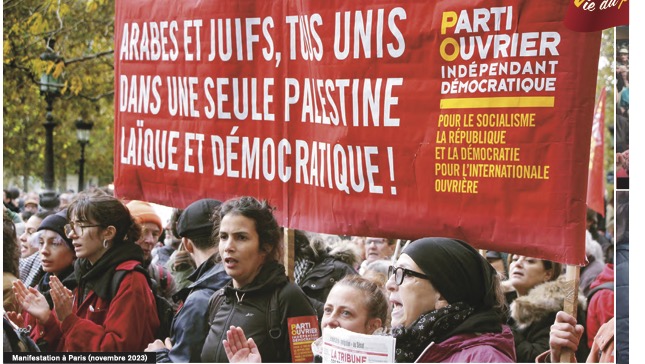
POID contingent in November 2 Paris rally. Banner reads: “Arabs and Jews, All United in a Single Secular and Democratic Palestine”
A West Bank Resident Testifies
“A friend from the Dheisheh refugee camp was killed this weekend, adding to the 220 killed in the West Bank over the past month.
“Israel and the Palestinian Authority are afraid of a new Intifada* in the West Bank. They know it could happen again at any moment. Over 3,000 young people have been arrested in one month, most of them under administrative detention without trial.
“Those who speak of a ‘two-state solution’ are blind to what is happening on the ground. The Zionists will not leave one square centimeter for a “two-state solution.” Look at what they’re doing in Gaza.
“We know that we are not alone. There are people in Iraq, Yemen and Syria who support us. We have seen the demonstrations in the United States and Europe.
“The people trust the American people more than they trust most Arab and Muslim leaders, who do nothing for the Palestinians.”
— Interviewed by our U.S. correspondent Mya Shone on November 22
* * * * * * * **
Israeli Assault on Jenin
During the truce in Gaza, the Israeli army attacked Jenin (northern West Bank), besieging its refugee camp and two hospitals. The West Bank is the scene of almost daily raids, incursions, and assassinations: over 200 killed since October 7.
* * * * * * * * ** *
The Israeli Army Promises “a Long War”
“Taking control of the northern Gaza Strip is the first stage of a long war, and we are preparing for the next phases,” said Daniel Hagari, spokesperson for the Israeli Army, on the eve of the launching of the November 24 truce.
* * * * * * * * * * *

5,300 Children Killed in Gaza
“More than 5,300 Palestinian children have been killed in just 46 days… that’s more than 115 per day”, said the Executive Director of the International of the International Children’s Emergency Fund (Unicef) on November 24. “The Gaza Strip is the most dangerous place in the world for a child,” she added.
* * * * * * * * * * *
 Socialist Organizer