
T.O. 93: Debt-Ceiling Cuts – Discussion with Harpreet Chima – LCIP Black-Working Class Panel – Railroad Workers United Organizers Speak Out
IN THIS ISSUE:
• Bipartisan Fiscal Responsibility Act Cuts Assistance to the Needy
• Discussion with Harpreet Chima on Crisis in DSA and Way Forward for Independent Working-Class Politics
• Panel and Discussion on Independent Black Working Class Politics at May 13 LCIP National Conference: Presentation • Nnamdi Lumumba Speaks • Khalid Raheem Speaks • Shafeah M’Balia Speaks
• Labor Party and Black Working-Classs Party: No Contradiction Between These Two Struggles – by the Editorial Board of The Organizer
• Labor Party and Black Working-Class Party: Marching to a Common Destination – by the Editorial Board of The Organizer
• Railroad Workers Speak Out at LCIP National Conference in Support of a Break with the Two-Party System
[International Antiwar Supplement will be published on June 5]
* * * * * * * * * * *
Bipartisan Fiscal Responsibility Act Cuts Assistance to the Needy
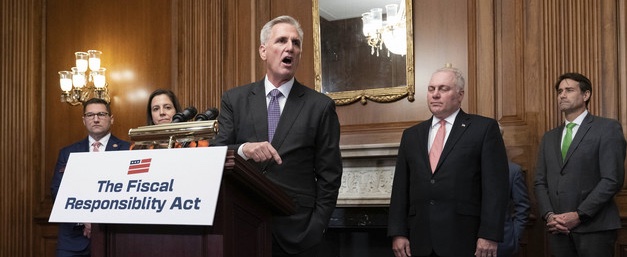
On May 31, the U.S. Senate, following the lead of the House of Representatives one day earlier, approved the “Fiscal Responsibility Act,” which ramps up the attacks on the U.S. working class with major cuts in public spending – all in the name of preventing a debt default. Raising the nation’s debt limit, now $31.4 trillion, would enable the Treasury to borrow to pay already incurred U.S. debts.
The bipartisan Fiscal Responsibility Act now goes before Biden, who is certain to sign it.
The contours of the debt-ceiling and budget cuts package were first presented by President Biden to the public at a G7 press conference in Japan on May 21. Biden reported that a deal had been reached with Republican House Speaker Kevin McCarthy that would cut spending for assistance to children, the elderly, and the poor by $1 trillion over the next six years as a means to reduce the debt (White House statement, AP, May 21).
Failure to approve the bipartisan agreement, Biden insisted, could lead to a “devastating” U.S. default and world financial crisis.
Of course, what Biden and McCarthy failed to point out is that the bulk of the U.S. debt stems from unbridled military spending, bank bailouts, and tax cuts for the rich. The debt crisis is largely contrived; its main function is to enable the twin parties of Big Business to continue chopping away at programs that benefit poor and working people.
If the ruling-class politicians were truly interested in reducing the debt — which, as former Labor Secretary Robert Reich noted is not really necessary – they could begin by slashing the military budget, confiscating the trillions of dollars doled out to the banks (estimated at $8 trillion), and making the rich pay their taxes.
It is worth noting that in 1996, the excuse of a debt default was wielded by then President Clinton as a means to abolish the federal welfare system.
What exactly is in the deal?
Changes to the SNAP program: The Fiscal Responsibility Act would require able-bodied, low-income adults without dependents between the ages of 18 and 54 to work in order to receive food aid under the SNAP food supplement program, up from age 49 currently. Under current law these adults can receive benefits for no more than three months within a three-year period, unless they are working or enrolled in a work program.
Let’s look at the reality of SNAP, a program meant to stave off hunger. Ninety percent of participants pre-pandemic were in households with a child under age 18, an adult age 60 or older, or an individual who is disabled and cannot work. In fact, children under age 18 constitute nearly half (44 percent) of all SNAP participants. Two thirds of SNAP participants are in families with children and one third in households with older adults or disabled people.
Income tests (at or below 30% of poverty line which means $28,550 per year for a family of three) and work requirements are already embedded in the SNAP food supplement program. Most unemployed non-disabled adults are limited to three months of benefits. The program requires adult recipients to work at least 20 hours per week or in a workfare or job training program. On average, SNAP participants receive just $127 per month ($4.16 per day) per person which makes it difficult to purchase an adequate diet.
The new restrictions will mean more people going to bed hungry.
IRS funding: The deal would cut $10 billion that the Internal Revenue Service funding had planned to use for a decade-long effort to boost tax enforcement and modernize its technology. Congress had provided $80 billion to those plans last year as part of the Inflation Reduction Act.
Not funding the IRS is yet another gift to the wealthy and corporations. The wealthy often have complex tax shelters – even hundreds of them – which require teams of forensic accountants to pierce and unravel. The IRS doesn’t have sufficient staff with these skills and, consequently, doesn’t attempt to review the intricate tax filings of the rich.
As a result, the easy pickings of low-income individuals and families are the primary targets of audits. These often are individuals and families who claim the Earned Income Tax Credit (EITC). More so, the IRS admitted on May 15 that Black taxpayers are three to five times more likely to be audited than others.
Environmental Trade-Off
“The Democrats are the party of responsibility,” Lawrence O’Donnell assured his MSNBC audience. Responsible to whom is what must be asked? Environmental activists were already enraged by Biden administration’s support of the Willow Project. This is ConocoPhillips oil drilling project on the North Slope of Alaska which aside from endangering wildlife will generate an additional 9.2 million metric tons of carbon pollution into the atmosphere each year and is only one of many major fossil fuel concessions slipped into the Inflation Reduction Act.
It’s apparent that Democrats take the young, climate-minded voters who helped elect Biden in 2020 for granted, but The New York Times speculates that they may have pushed too far when White House negotiators on the debt limit bill undermined another longstanding environmental struggle.
This is the $6.6 billion Mountain Valley Pipeline which will transport natural gas about 300 miles from the Marcellus shale fields in West Virginia across nearly 1,000 streams and wetlands before ending up in Virginia. (Federal regulators have estimated that if all the natural gas carried in the Mountain Valley Pipeline were burned in power plants and homes, it would release about 40 million tons of carbon dioxide a year.)
Environmentalists along with civil rights activists who have kept completion of the pipeline tied up in courts for a decade now feel “stabbed in the back.” [Climate Defiance on Twitter]
Why? It was White House negotiators, not Republicans, who inserted pipeline language into the debt limit bill that will make all current legal challenges to the pipeline moot and, furthermore, potentially block all future lawsuits.
Money for Jobs and Social Services — Not for War!
At the end of December, the U.S. Congress passed the budget for fiscal year 2023, earmarking over $1 trillion for the Defense Department and other military spending.
At his press conference in Hiroshima, Biden once again affirmed his commitment to yet more funding for the war in Ukraine. He announced a further $375 million in military aid to that country, on top of the $113 billion already allocated in FY 2022.
The new cuts in public spending are therefore a means of financing this war budget.
The billions of dollars that are feeding the U.S. war machine should be redirected for hospitals, schools, and public services.
[At his press conference in Hiroshima, Biden once again affirmed his commitment to yet more funding for the war in Ukraine. He announced a further $375 million in military aid to that country, on top of the $113 billion allocated in FY 2022.]
It should be apparent to all by now that the Democrats will sell out working people and oppressed communities. That is why it is imperative for us to mobilize together, to create our labor and community assemblies and accelerate the process to create a working-class party rooted in labor and oppressed communities.
* * * * * * * * * *

Discussion with HARPREET CHIMA on Crisis in DSA and Way Forward for Independent Working-Class Politics
Harpreet Chima is a member of Democratic Socialists of America (DSA) based in Stockton, Calif. In 2022 he ran for U.S. Congress in California District 9 as a Democrat, garnering 6.67% of the vote in the Democratic Party primary in an election that was ultimately won by incumbent millionaire Josh Harder.
On February 25, 2023, he participated in the LCIP antiwar conference in Davis, California, and on May 13 he participated in the LCIP online national conference.
On May 29, he met up with The Organizer editorial board member Alan Benjamin to discuss the crisis in DSA and what way forward in the fight for independent working-class politics. Following is the edited transcription of this discussion.
ALAN BENJAMIN: Last January, we published in The Organizer an account of a public discussion among various left-wing currents within Democratic Socialists of America (DSA). One of the main points all these groups had in common was their characterization of the current situation in DSA as a crisis — a crisis stemming from their “over-reliance” on the Democratic Party.
There was a collective attempt to figure out what were the root causes of the crisis and what should be done about it. After publishing major excerpts from the various DSA presentations, our editorial board concluded that while a strong critique was made of the Democrats, the forum participants failed to get at the root of the problem, which is the need for a “clean break” with the Democratic Party. What is your assessment of this discussion and of the crisis in DSA today?
HARPREET CHIMA: I am not active in DSA these days, but I think that in DSA there is definitely a realization that you can’t carry on as we’ve been carrying on. But the solution offered is to shift to the “dirty break.” There is only one current that I know of — Red Labor DSA — that is calling for a clean break, but I think their opinion is in the minority.
Basically, the dirty break means that DSA will separate from the Democratic Party eventually, but for now, we need to get more DSA candidates elected as Democrats. Our DSA candidates will show people that the Democratic Party is not working for them, and then, once we have big enough base, we’ll separate from the Democrats and build a Labor Party.
Personally, I disagree with this position. I think that you’re being dishonest with voters. Running as a Democratic only strengthens the Democratic Party brand; the Democrats have been very good at hijacking left-wing talking points.
We all know how it works: Once you’re in office, unless you’re willing to be a one-term candidate, which a lot of people aren’t (because it costs a lot of money and time to actually win), you can’t spend your entire time just calling out corruption or advocating for policies that would truly break from capitalist domination.
But if you don’t do that, that is, if you don’t advocate and campaign actively for policies that benefit the working class and all the oppressed, you’re just going to get co-opted back into the Democratic Party machine. If you want to pass reforms so that you keep your seat, you end up having to legitimize the Democratic Party or make excuses for their betrayals to your base because that is all you have to offer in exchange for their support.
If you are negotiating with them like this, your reform is already going to have to be watered down significantly. But it allows them to give lip-service to your platform, making them sound more “progressive” to their and your base. And then in the end, the most likely scenario is that they find an excuse to not push through your legislation anyway.
You need a base of people who are willing to take a longer view in the fight for socialism — people who build stronger labor unions and community organizations, like tenants’ organizations. A base that is willing to build dual power institutions while also fighting in the electoral arena. Everyone reading this is certainly taking that view. Why do we assume the rest of the working class can’t also?
You need people willing to campaign for ballot measures, as long as they’re bottom up – ballot measures that are developed by labor and community coalitions – which is very different from some group coming in and saying, “Hey, we have a ballot measure for you.”
You have to be honest with voters and tell them why you don’t think voting for the Democratic Party is going to get us anywhere, and here are X, Y and Z reasons why this is so. There are plenty of reasons. Just look at the agreement that Biden worked out with the Republican Party for passing the debt limit.
Here you have a Democratic president who is cutting back on SNAP (food assistance programs for the needy) and cutting back on benefits, while the military budget is skyrocketing. The Democrats could have avoided this three years ago when they had power, but they decided not to. Whether it was an honest mistake, cowardice, or intentional, the result was the same.
ALAN BENJAMIN: The editorial board of The Organizer has long argued that the “dirty break” is no break at all. It does not create more propitious conditions for breaking with the Democratic Party down the road. Quite the contrary; it only prolongs and deepens the co-optation.
Now for my next question: You have launched a new organization based in Stockton, California: Working Class Unity. From what I understand, this is mainly a localized initiative in Stockton, but do you intend to develop it on a state-wide or national level? Tell us about this effort.
HARPREET CHIMA: Forging a new independent organization on a local level is a much harder task. Building Working Class Unity is going to be slow going. You’re very far removed from a seat at the table if you’re going to depart and do things independently. And that’s fine with us.
The Democratic Party in Stockton is relatively weak, but they have people who do have power and a lot of money. Their vision of politics is top-down, so there’s really no way to work with them here — which is why we’re setting off independently. Our goal, our Part One, is basically 300 dues-paying members by this time next year – 300 people who understand how politics actually works.
We want people to move beyond just outrage to understanding how society works and how the institutions in it work. Three hundred people who can go to their families and friends and point out the funders and donors who are behind the city council members making the decisions. Members who can explain the connections between our school system, local employment opportunities, and how the dysfunction is benefitting a handful of people.
We also will be pushing back against a lot of these so-called community organizers who come in with a lot of money and then ask for people’s support saying that they’re going to solve a lot of the issues related to poverty in Stockton. But really, they just want grant money from the city for their own personal benefit. We’re not going to go out and get grants from large foundations to do this work.
And part of that is critiquing the class character of race politics. You have millionaires and wealthy business owners saying they speak for certain poor and working-class communities while pushing for policies that have no benefit to the mass of working people.
Organizing at the local level is a lot more difficult. Generally speaking, people understand how legislation passes at the national level, but how many people can tell you how it passes at the local level – even though legislation at the local level is what affects them the most?
Part Two of our plan entails becoming part of the social fabric in the city, dealing with school issues, sporting events, housing, recreation, climate change, police accountability — whatever it takes.
Frankly, I don’t know how this effort is going to grow nationally. Once groups like this grow in prominence locally, then it makes more sense to start talking about the state level or the national level. But for now, I think that complicates things. I just don’t think we’d have the bandwidth for it, at least for a while.
ALAN BENJAMIN: As you know — having attended the February 25 conference in Davis, California, of Labor and Community for an Independent Party (LCIP), and then the May 13 National Conference of LCIP — trade unionists, political activists, and community activists from across the country have joined forces to build LCIP on the grounds that the Democrats and Republicans cannot be reformed.
They also have concluded that we need a new mass political party representing the working class and all oppressed people. Initially, such a party, if it is truly independent from the parties of the bosses and if it advocates consistently in favor of the dispossessed, need not be a socialist party, though we as socialists would advocate that it adopt policies that make greater and greater inroads into capitalist relations of production and distribution (nationalization of railroad industry, single-payer healthcare, self-determination for oppressed nationalities, etc.).
What is decisive is that the labor movement break with the Democratic Party to build such an independent party rooted in the trade unions and communities of the oppressed. Labor’s subordination to the Democrats, we have stated time and again, is the main obstacle facing working people in their struggle for peace, jobs and justice.
There are a whole host of transitional demands that raise the issue of socialism as the only lasting solution to capitalist depredation. In that sense, we believe that working class unity must be predicated on independent working-class politics – and we are convinced that there is more openness than at any time over the past 60 years to this perspective.
We agree with you that our efforts must begin at the local level, which is why we believe that your effort with Working Class Unity, sooner than later, will need to adopt an electoral component. This is what is happening in the state of Maryland, where a Black-led working-class party – the Ujima People’s Progress Party – is readying to get on the ballot to couple its on-the-ground organizing efforts with running candidates on a local level.
It’s happening in North Carolina, where Black Workers For Justice and the Southern Workers Assembly are promoting labor-community assemblies across the state that develop program, identify the issues that people can rally around, and run candidates for local officers that are answerable to these assemblies – all of which are viewed as stepping stones to building a mass-based political party and dual power. [See presentation by Shafeah M’Balia in this issue.]
This discussion reminds me of the point that David Van Deusen, president of the Vermont AFL-CIO, made in this presentation to the May 13 LCIP National Conference. He said he supported the call for a national labor-based independent political party but felt that it was premature to take even limited local-based efforts in this direction at this point. What must come first, he stressed, was the development of a massive fightback caucus – like TDU (Teamsters) or RWU (Railroad Workers) — across the entire house of labor.
LCIP’s response to Brother Van Deusen is that, yes, developing a massive fightback movement in labor is necessary, but it is not contradictory to building the initial stepping-stones toward a labor-based independent working-class party. We can — and we must — expand the scope of the labor-community assemblies and local candidates today. We can do both things; in fact, building these alliances will only help develop the independent fightback movement in labor.
So what, Harpreet, are your thoughts about LCIP? Is this something that Working Class Unity would like to explore and possibly even join?
HARPREET CHIM: I don’t make any decisions myself. We’d have to take this to the membership for a vote. But I think that groups like LCIP are really important. One thing that I keep running across is that so many of the things that we’re trying to figure out and fight for, other groups have done this before or are doing it now.
Groups like LCIP bring organizers together to discuss and talk about what’s worked and what hasn’t worked as we take on this kind of local organizing.
In terms of running candidates, I think that, too, is important. More and more people are realizing, yeah, we’re just running into a brick wall with the Democrats, so let’s try something different. I think it’s great that all these groups in Maryland and North Carolina are coming out and running as independents. Hopefully we in Stockton can run candidates once we have the capacity to do so.
But we are not going to just endorse people and volunteer for their campaign. If we’re going to endorse someone, it means that Working Class Unity is basically running their entire campaign. That’s how we’ll be able to hold candidates accountable. It’s about running candidates who are the vessel with which the entire group will have power at the local level.
Running independently is key. One thing I ran into when I was running in 2022 as a Democrat for U.S. Congress in California District 9 was that if you run as a Democrat, you end up having to take on and answer for the sins of the Democratic Party, even though you’re totally against what they’re doing.
Also, I believe that running after the Democratic Party’s primary voters is a big mistake because the DNC has been spending a lot of time shaping the electorate that they want. It’s an electorate that includes, yes, a majority of people on the lower end of the income scale, but also a majority of the people who earned $200-K plus. And it’s the high-income supporters that really shape the narrative and the electorate through donations and volunteering.
So when you go to working-class people, they don’t like what the Democratic Party has been doing. They will hold you to account, even if you’re trying to do a dirty break. So, yes, the only way around this is to run as independents and form community coalitions.
I think that the work that LCIP is doing – and that other groups are doing – is a good model for groups like Working Class Unity to look at and emulate. I will certainly take this issue to the rest of the membership and see how we could coordinate and work together. I think that would be really beneficial.
ALAN BENJAMIN: Is there anything else you would like to add?
HARPREET CHIMA: For anyone reading this exchange who may want to start their own group, you can contact us at info@workingclassunity.com. We are trying to keep good documentation on the decisions we are making and why we are making them. I think it is important to keep for our future members to look over, but hopefully it is also useful to others as well.
Trust me: There are hundreds of people in your city who think like we do. Reach out to them. All it takes is a handful of people to start.
* * * * * * * * * * *
Panel and Discussion on Independent Black Working Class Politics at May 13 LCIP National Conference
Presentation
We are publishing below a dossier on independent Black working class political action. It includes the edited transcription of one of four panels at the May 13 LCIP National Conference of Labor and Community for an Independent Party (LCIP) and an editorial statement on this issue by the Editorial Board of The Organizer. The three LCIP conference panelists are Nnamdi Lumumba, Khalid Rasheem, and Shafeah M’Balia. — Editorial Board of The Organizer
* * * * * * * * * * * *
NNAMDI LUMUMBA SPEAKS

Introduction by panel chairperson LISA KNOX, immigrant rights attorney and member of the LCIP Continuations Committee
Our first speaker is Nnamdi Lumumba, Nnamdi is a founding member and current state organizer for the Ujima People’s Progress Party (UPP) in the state of Maryland. He has worked throughout the United States as a revolutionary Pan-African internationalist organizer working in Black communities around the issues of police brutality, housing, education, economic development, reparations, and social justice. He has participated in the effort to win reparations and to free political prisoners such as Marshall “Eddie” Conway and Mumia Abu-Jamal. He has also been a local city council candidate in Baltimore and served in multiple campaign committees of several Black independent candidates. So with that I will turn it over to Nnamdi.
Thank you, Comrade Lisa.
I think it’s very important to add this piece to the discussion of independent working-class political action. There has always been a necessary discussion – from the very beginning of the creation of the United States – about how to resolve the question of the African population that was captured on African soil and brought here as chattel to build the U.S. economy.
Linked to this is the need to address the issue of the land itself, which was stolen from the indigenous people – even if these questions aren’t always widely discussed in the mass media or in the political arena.
The fact is that these things underpin all the economic and social structures that are now present in the United States, which underscores the role that Black independent political parties are going to play. They will be a key part of the movement of any independent political party – especially political parties that are worker-based and that are anti-imperialist, anti-capitalist, and anti-racist.
I say this because there have to be organized structures in which African working-class people can organize their ideas, defend themselves and their communities, and also have the kind of political clout in the broader working-class struggle.
Also, just because we struggle against an oppressive ruling class capitalist class in America, this does not mean that there’s going to be a sort of “mystical” end to racism. We know that even within the left itself there are racist attitudes and positions, and often-times non-white workers are simply seen as attachments to the broader, larger working-class struggle.
These racist positions – whether in their homes, jobs, schools, or communities – have to be called out, and such positions by politicians who are engaged actively in those positions have to be exposed.
We also must address how U.S. foreign policy impacts African and other non-white people around the world. This must involve more than “solidarity”; it has to actually recognize that the people being oppressed represent our nation.
This includes the nations that we were stolen from. Many of us are very connected to the struggles of African people, not just throughout the United States but throughout the Americas, and in Africa as well. This is work that we’re doing here in Maryland.
We strongly align with the question of building a Labor Party rooted in radical unionism and the struggles of oppressed peoples. But that is only part of the answer. Black workers themselves have the ability and necessity to be organized independently – so that, independently, they can bring their ideas to the table. And those ideas are not dependent upon the support or approval of non-African people.
We are an anti-imperialist movement.
Quite naturally, we are an anti-racist movement and an anti-capitalist movement because we understand the issue of class in America and the role that capitalism plays in our oppression.
We have taken a strong stance against colonialism both within the U.S. borders, and externally, and we have exposed the role of neo-colonialism.
We often see Black and Brown faces in power in the United States, most often in the Democratic Party, but increasingly in the Republican Party as well. These Black officials do not represent the interests of Black workers or the Black liberation struggle. They have been sucked into the Democratic and Republican machines. They represent factions of the Black middle class.
Sometimes we call these people out to help people understand what we mean when we refer to them as the Black mis-leadership class.
Our goal is to create a platform and campaigns that will openly take up the struggle against members of the Black middle class who are neo-colonialists in their policies, who support economic and political policies that push people out of their communities, and that deny resources to our communities.
We must challenge these politicians; we have to call them out. We have to explain to our communities and our allies who these people are – that just because they’re Black does not mean they represent the interests of Black Liberation.
We in the Ujima People’s Progress Party are moving to build our organization as a statewide party — a party that allows everyone to join under the leadership of African workers.
We have always put forth as a vanguard community the struggle against racism, against colonialism, and for national liberation. We have always held that people can join these organizations with the understanding that they are not going to pull African workers away from these struggles, but instead will join these struggles. Independent Black political parties allow us to have the institutions to do just that.
* * * * * * * * * * *
KHALID RAHEEM SPEAKS

LISA KNOX: Thank you so much, Nnamdi. So now we’ll go to our next speaker Khalid Raheem. Khalid is a community activist and organizer living in Pittsburgh, Pennsylvania. He is the founder and chairman of the New African Independence Party, and a former veteran member of the Black Panther Party. He is also the author of several books, including “Dare to Struggle, Dare to Win and “To a New African Revolution,” and he also serves as a member of the Continuations Committee of LCIP. So now I will turn it over to hi
Thank you all. I appreciate the opportunity to be part of this great conference and to be part of this panel to deal with this particular issue.
This is not the first time historically that there have been serious meetings and discussions around independent Black political parties and independent Black political formations, and their relationship to a much larger working-class movement and working-class struggle.
Earlier, on the previous panel, one of the panelists emphasized how important it was to develop a working-class party, and one of the things that I think we need to recognize is that we need to work on developing a radical working-class political movement – not just one particular party to add to the duopoly.
The United States continues to be one of the few so-called “developed” countries in the world that has an almost exclusive two-party system. Other western imperialist nations have multiple parties that represent various political perspectives and sometimes various political tendencies.
I think that as we go about the process of doing this work, our goal needs to be to completely transform how politics are conducted here within the United States of America, and for Black folks, our mission is even much more specific: our mission is to use politics, electoral politics in particular, as a vehicle to advance the agendas of Black freedom and Black Liberation.
Our struggle is not just to struggle for rights. Our struggle is not just to struggle for inclusivity. We’ve already waged that struggle. We went through that struggle already, right?
The Voting Rights Act was passed. The Fair Housing Act was passed. Pivotal years were 1963, 1964, and finally 1968, when that period came to a close.
In the post-Civil Rights era, we are witnessing two developments: neo-colonialism and what we call the post-industrial era, which gave rise to the madness that we see going on today specifically within our communities.
I just want to make it clear that it’s not just about building one more party that adds to the Republicans and that Democrats. It’s about a wholesale radical overhaul of what politics looks like and how things function politically here within the United States
The other point I would like to make concerns Black folks. We come from enslaved Africans, enslaved Black workers, who were the most exploited group of workers historically within what became the United States of America.
This is not exactly the case today. l would say that immigrant workers are probably one of the most exploited groups of workers here within the United States.
I would say that people of color, Black and Brown, who happen to be incarcerated are some of the most exploited workers here in the United States.
So, as we talk about organizing workers, we’re talking about joining the links and making the connections between all exploited workers and the Black Liberation movement. Incarcerated workers produce a growing percentage of commodities in this country, but they have no rights or organized power.
We Black folks are the sons and daughters, and the grandchildren and great grandchildren of enslaved Africans.
We represent a super-exploited group of workers here within the United States. Our role was very unique during that era, because we were the labor engine of both the systems of slavery and emerging capitalism, two systems that were in contradiction with each other. Many times people forget that slavery is an economic system, not just a social order.
So as we move forward, we have to understand that it’s not just about liberating workers in general or giving more rights to workers and Black people. Our struggle has to be for self-determination – about whether we want to continue to be part of the experiment called United States of America, or whether we want to be something else.
That’s what self-determination means for us. And that’s why this is so important for us to have this type of conference.
We can talk about bridging the gap between the aspirations of oppressed Black people and the aspirations of oppressed segments of the working class. But how do we bridge the gap? How do we move forward?
I’ll close with this: We need to be focusing on developing a movement, not just another political party.
* * * * * * * * * * *
SHAFEAH M’BALIA SPEAKS
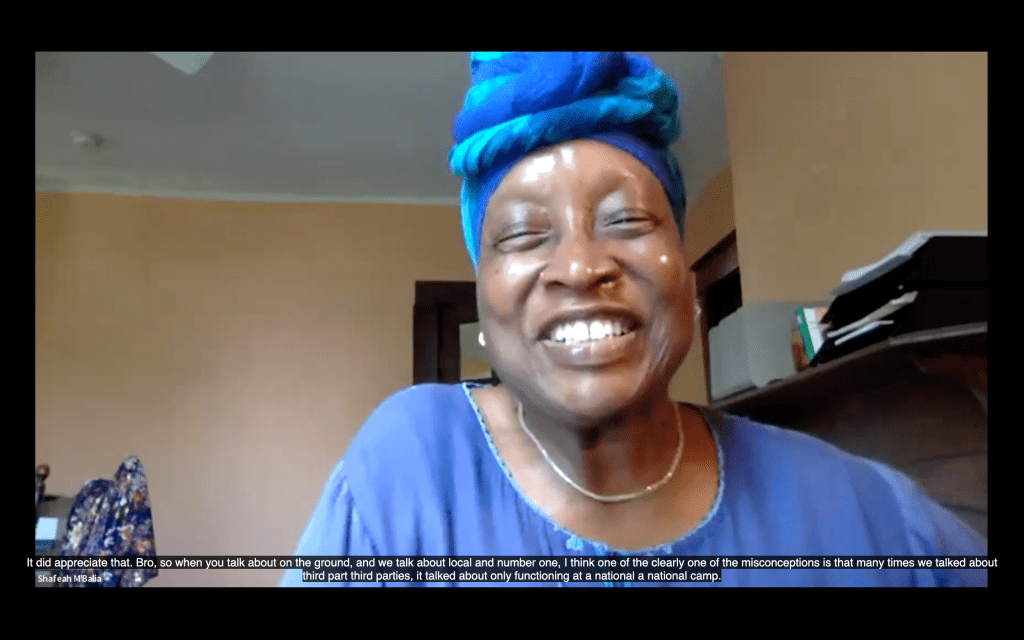
LISA KNOX: Last, but certainly not least, we have Shafeah M’balia . Shafia is the Southern Regional Coordinator of the Imam Jamil Action Network, fighting for the exoneration of wrongfully convicted Imam and human rights activists. Imam Jamil Al Amin was formerly known as H. Rap, Brown. Shafeah is a member of Black Workers For Justice (BWFJ), a founding member of Muslims For Social Justice and co-director of a community educational development institution focused on developing and promoting Black working-class leadership as part of the U.S.-based national Black Liberation Movement. So I will turn it over to Shafeah.
In the name of God, and greetings to everyone.
Thank you for that introduction. We are Black Workers For Justice and we are glad to be a part of continuing efforts to build an alternative to the Demopublicans – and ultimately defeat them and the system of oppression and exploitation that created them.
We’re also happy to join our comrades in the Black Liberation Movement fighting on the ground: the Ujima People’s Progress Party and the New African Independence Party.
We look forward to working directly together with you in the future. I just want to note the levels of unity expressed on this panel between our different positions as we attempt to address some of the concrete work we have been engaged in.
Black working-class independent political action has been part of BWFJ’s basic program since our beginning. I’ll take a moment to refer to Point 7 of our program where we stand for universal voter registration, independent worker control and political parties, and power with justice – using an electoral system where working-class Black youth, women, indigenous and other oppressed people have control of the process.
We’re for eliminating the domination of political parties by the wealthy elite and the corporations, as well as their institutions. We are for human rights, for building self-determination, for building creative and effective forms of contending and transformative power to challenge the powers that be.
We specifically name the system as capitalism and imperialism, both in terms of internal colonialism as well as external colonialism. We take our viewpoint from a critical analysis of the history of Black people’s relationship as a foundation of its blood-sucking economic system through slavery and later Jim Crow.
We’ve made an economic, cultural, geographic, and political analysis of where the majority of our people are in the U.S. South, and the South’s role within the capitalist system internationally as well as inside its national borders.
Here is some of what we have learned:
Number 1: We’ve concluded that 56% of Black people in the U.S. are in the South. Generally contiguous counties run across rural, semi-rural, and cities across the South.
Number 2: Local, rural, and semi-rural infrastructure are more accessible to challenge and learn governance by independent and non-partisan Black worker and oppressed organizations.
Number 3. Black workers continue to be central to organizing within the labor and trade union movements; we must push that movement to accept independent political action and political party building, independent of the Demopublicans, understanding the widespread role of racism across the U.S – and that includes, as our brother has already mentioned, inside the labor movement.
We are also central as workers to the Black Liberation movement, because the majority of our people are workers, and their issues are central to our existence and must move to the center of our movement-building efforts.
Number 4. We need to promote coalition-building across the community, anchored in peoples’ and workers organizations, and with unions at the base. The union base is central to building a challenge at the local level, which, of course, will be connected to the national level.
Number 5. The power never, ever concedes without a fight – never has, never will.
Therefore we see the importance of Black Political Action – Labor Party-building alliances.
These alliances need to be understood as stepping-stones to contend with and ultimately displace this system, which will never allow an alternative to “coexist” within it.
Our history of organizing and coalition-building includes work in Fremont, Norfolk, and Wayne County, where the coalition-building effort between the Fremont Fair Labor Support Committee, the Fremont Concerned Citizens, and the FEMA Health Committee built a Black majority coalition that ran a slate that won the town Council and began to strengthen the local electoral infrastructure, local recreational facilities, and the Fremont Health Screening Program. There is a clinic – which has existed for more than 30 years – that is empowered and directed by local community organization.
We were also instrumental in helping to build a coalition, also in North Carolina, that was led by the Consolidated Diesel workers at a plant that was adjacent to the unincorporated community called Bloomer Hill.
Their community is in association with the Black Whitaker’s Community Association, which ran a slate of candidates and won the town council, making it a majority Black council for the first time since Reconstruction. They defeated local white farmers who had dominated the area and had incarcerated, for all intents and purposes, immigrant farm workers who were fundamentally enslaved on their farms.
There is a growing movement across the country, especially across the South, of People’s Assemblies. We cite, for example, the Spirit of Mandela and a people-centered initiative – the Southern Workers Assembly. We cite the Southern Movement Assembly, as well as local assemblies and various forums in Alabama; Jackson, Mississippi; Nashville, Tennessee; Raleigh; Newborn; the Durham Workers Assembly, and the Virginia Beach Assembly.
These and other assemblies are growing across the South. We see these as spontaneous and not-so-spontaneous democratic processes that are developing demands, programs, and defensive-contending action plans and alliances with the aim of eventually knitting together challenges to Capital. Such alliances would establish dual and contending power, forming the basis, the mass basis, to unite the Black Liberation Movement with other oppressed peoples, and the labor movement.
We see these coalitions, the assemblies, as stepping-stones to form the basis, the mass basis, for our national liberation movement – to consolidate the power of all people who we recognize as internally colonized – a movement that would then move to the next level.
We look forward to working together with other workers’ movements – with the New African Independence Party and the Ujima People’s Progress Party in building from the base up a truly independent and contending force to ultimately challenge capitalism at its base, as well as in building a new society, both for the question of self-determination and national liberation for our people, and freedom for other oppressed and working people.
RESPONSE BY SHAFEAH M’BALIA TO A QUESTION
There is a misconception when we talk about third parties. We talk about them functioning only at a national level, as a national campaign. We cannot hope to outspend the Democrats, the Republicans, or any of those big-monied interests.
To run a national campaign, you must be a millionaire. If you’re not one, the question becomes where are you going to get money for that, and who are you beholden to? Is it some corporate entity?
At the state level, state laws are designed to X folks out.
But at the local level, there is not only the possibility of being able to build a campaign at a level of resources that are attainable, but it also forces you in a position to do the groundwork that both brothers [Nnamdi Lumumba and Khalid Raheem] are talking about.
It’s about building a ground campaign that is designed by the people. One of the reasons why the assembly movement is so important is because the assemblies could be, and should be, moving to the step of developing programs. That is also where people can be trained to work in the community — in the zoning boards, the library boards, and all kinds of “volunteer commissions” that teach people about governing and about representation.
All this research helps build infrastructure on the ground, knit that together, and build the next stage, which is a people’s program.
This is where we test each other: Is Shafeah consistent. Is she dependable? Does she have a track record? Is she accountable to the people in the people’s assemblies, or is she accountable to, you know, those folks who throw money around?
This is how you build permanent organization that is linked to those issues the brothers talked about: housing and gentrification, police, water, sewer, environmental racism … all those kinds of issues that folks are fighting for on a daily basis.
This is where we recruit our candidates and we build an independent infrastructure that begins to work its way up. It’s about organization at the workplace as well as organization in the community.
Our campaigns must be locally based. They must be anchored in worker’s struggles, both in and outside the workplace, and grounded in community struggles – irrespective of whatever state lines that may exist.
There are many examples of success across the country. One in particular stands out: the People’s Coalition Against Charter Change in Philadelphia. Real motion happened when this Black united front began organizing from the block level to the precinct level. The Black community throughout the city and state fought back. It was almost like hand-to-hand combat — and it defeated the charter change campaign and broke the Frank Rizzo machine.
Now, what it did not do was break the local Democratic Party machine, which ended paying off folks. But in the interim, what was developed was a citywide Black united front that created the Philadelphia Black Human Rights Agenda (a copy of which we are still trying to locate, as it is an historic document).
This Black united front involved all levels of organization within the Black community — from the churches to the motorcycle clubs, to the block campaigns, to the gardening clubs, to the women’s groups, to the nationalists. Everybody and their mama was a part of this fight.
This is the kind of organization that we are talking about building. That’s the kind of place that we have to go to.
It’s not a question about whether the people will fight — the people will fight. The question is program, leadership, and organization.
* * * * * * * * * * *
KHALID RAHEEM RESPONSE TO A QUESTION FROM A PARTICIPANT
Thank you. I would also like to add to my bio the work that I do around the Independent Radical Black Union. I serve as the Vice President for community organizing and engagement with the New African Workers Union.
We are also very proud to be associated, for example, with United Electrical Workers Union Local 150, the North Carolina Public Service Workers Union, which has taken a strong stance in support of the Black working class. Most of its members are sanitation workers, technicians in the university, workers in the state system.
I would like to address the question about our attitude toward the organized labor movement and the fight against racism.
Yes, there are reactionary borderline white supremacists and racists at all levels of the organized labor movement. These are questions that go back over a century ago, and we still haven’t resolved them.
This is one more reason why politically as well as organizationally the Black workforce needs formations like Black Workers For Justice and the Ujima People’s Progress Party – and unions like the New African Workers Union. We have to determine for ourselves what is in our own collective best interests.
We cannot leave it in the hands of even the most progressive members of the white working class, because sometimes as a result of the impact of racism and the attractiveness of white supremacy, with all the benefits that come with it, these white workers ignore us or walk away.
Also, if you look at the history of the United States, the strength of any kind of anti-racist position has always been more or less linked to the strength of Black working-class organization, to the strength of the Black Liberation Movement. When these movement are at their strongest point, this has allowed other folks, including white workers, to take a non-racist position. The emphasis, we believe, needs to be on strengthening the infrastructure of the Black Liberation Movement.
* * * * * * * * * * *
Labor Party and Black Working-Class Party: Marching to a Common Destination
By the Editorial Board of The Organizer
Some of our readers may ask: Isn’t there a contradiction between calling for a Labor Party rooted in the trade unions and oppressed communities and supporting a Black working-class party, or parties?
The 1963 “Freedom Now!” resolution adopted by the Socialist Workers Party helps us understand why there is no contradiction between these two struggles.
The resolution notes that, “the labor and Black movements march along their own paths, but they march to a common destination, and the freedom of the Blacks from oppression and of the workers from exploitation can be achieved only through the victory of their common struggle against capitalism. … Blacks cannot win their goal of equality without an alliance with the working class.”
The SWP resolution goes on to note, however, that “the tempos of development of the two movements are uneven,” and that “Blacks may first want to unite in their own party in order that they can be able to bring about an alliance of equals, where they [the Blacks] can be reasonably sure that their demands and needs cannot be neglected or betrayed by their allies.”
In continuity with this revolutionary tradition, The Organizer Weekly, the publication of Socialist Organizer, maintains that you cannot fight effectively against racism if you don’t wage the most resolute fight against capitalism; conversely, you cannot fight effectively against capitalism if you don’t place front and center the fight against racism.
That is why we support the formation of a Black Workers Party closely linked to the struggle for a Labor Party. — The Editors
* * * * * * * * * * *
Railroad Workers Speak Out at LCIP National Conference in Support of a Break with the Two-Party System
[Note: Following are excerpts from the presentations to the May13 LCIP National Conference by Railroad Workers United (RWU) rank-and-file leaders Mark Burrows and Ron Kaminkow.]
MARK BURROWS SPEAKS
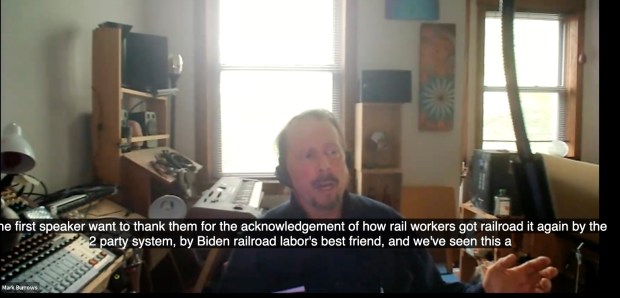
[Mark Burrows is a retired locomotive engineer and past co-chair of Railroad Workers United. He is currently the editor of the RWU quarterly newsletter.]
Personally, I’ve been convinced of the need to break from the two-party system for over 40 years. Now we have yet another reminder of why this is necessary. We just got railroaded again by the two-party system – by Biden, labor’s so-called “best friend.”
There was direct government intervention to stop us from striking, but the rest of the time there is still intervention, even if not directly by the Railway Labor Act. We are told, for example, that we have no choice but to ratify a contract because “you don’t want it to go to a third party.”
No, the Democrats can never be the friends of labor. It’s a myth, a fairy tale.
We have to call them out, and that includes calling out the union misleadership, both for their policies on the job as well as their political orientation, which is not going to budge even after all that has happened. Again, we are being told to get out the vote for our “friends of Labor” and the Democratic Party.
I want to read you a resolution that was adopted by the RWU Steering Committee on October 6, 2020. It states the following:
“RWU Resolution on U.S. Elections
“Whereas, the current two major political parties in the U.S. – the Democrats and the Republicans – are closely aligned with big business, corporations and the wealthy as to be almost indistinguishable from one another; and
“Whereas, as a result, organized labor – including rail labor – has few reliable friends in the U.S. government that can be counted on to actually stand up for working people and unions; and
“Whereas, each election cycle, workers are all too often reduced to voting for “the lesser of two evils” as a result of this two-party corporate monopoly of our political system.
“Therefore, Be it Resolved that RWU calls for working people and their organizations – together with community groups, environmental organizations, consumer advocates, and others – to break with the two-party corporate dominated political system and explore other avenues, including but not limited to, the founding of a new political party, in order to achieve our goals.”
That is part of the message that that we take to our coworkers and to our allies.
Our arena is the railroad. That’s the arena we’ve been handed, where we spend the better part of our time fighting for labor, for dignity.
But this is only part of the bigger arena for the overall fight for social justice, an arena in which all of us are victims of the rot of capitalism. That’s what this really is all about.
We are all victims of the rot of capitalism, that’s what this is really about.
We, working people, need our own economic policy. We need our own foreign policy to put an end to all the genocidal wars. This is all part of the bigger fight for social justice on a national and ultimately world scale.
* * * * * * * * * *
RON KAMINKOW SPEAKS
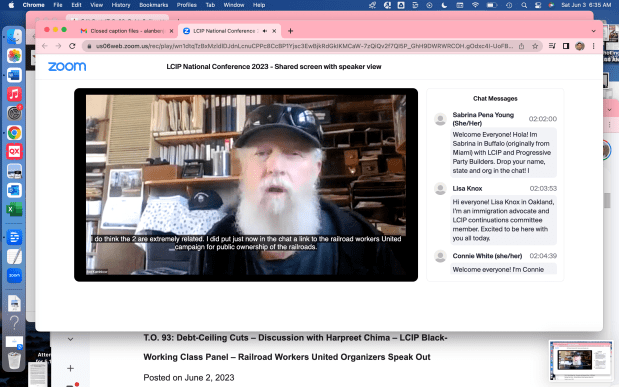
[Ron Kaminkow is past co-chair, now retired, of Railroad Workers United, currently a regular contributor to the RWU’s newsletter.]
Railroad workers are and should be in favor of a break with the Democrats and Republicans very quickly. Both parties have basically conspired against railroad labor and the ability of railroad labor to defend itself.
The vote in 1991 to send railroad workers back to work in the House was 400 to 5. I don’t know who those five people were, but obviously the vast majority of Republicans and the vast majority of Democrats saw fit to come together on an issue that they could certainly agree on — and that was to hell with railroad labor and the rights of railroad workers to strike.
So if there’s any group of workers in this country that have had a long and sordid history of 150 years of seeing their strikes and their solidarity and their power broken by the two parties, it’s railroad labor.
 Socialist Organizer